
MOIT VIETNAM | Increasing Numbers of Vietnamese Business Projects Operate Effectively, Making Positive Contributions to Lao Socio-Economic Development Across All Sectors
/ News
Increasing Numbers of Vietnamese Business Projects Operate Effectively, Making Positive Contributions to Lao Socio-Economic Development Across All Sectors
The Vietnam-Laos Investment Promotion Conference served as a significant event for both nations to review recent investment cooperation results. It also provided a forum to discuss and internalize measures to implement major orientations in economic, investment, and trade cooperation as agreed upon by both sides for 2026 and the 2026–2030 period.
The conference reviewed the status of Vietnam-Laos investment cooperation and introduced the business investment environment, incentive policies, and priority sectors of each country. Discussions focused on the potential and strengths of each nation and the future direction of investment, particularly in sectors such as electricity, rubber, agricultural processing, and chemicals and minerals. Special attention was given to the progress of key transport infrastructure projects connecting the two countries, namely the Hanoi-Vientiane Expressway and the Vung Ang-Vientiane Railway.
The conference assessed that, based on the foundation of excellent political relations, economic, trade, and investment cooperation has seen significant developments. The total bilateral trade turnover continued to record remarkable growth in the first 11 months of 2025, estimated at 2.6 billion USD, representing a 50.4% increase compared to the same period in 2024. Laos consistently maintains its position as the top destination among 85 countries and territories where Vietnam invests abroad, while Vietnam has risen to become the second-largest foreign investment partner in Laos.
To date, Vietnam's total registered investment capital in Laos exceeds 6.21 billion USD. In the first 11 months of 2025 alone, Vietnamese investment in Laos reached over 590.3 million USD, a 7.5-fold increase compared to the same period in 2024. An increasing number of Vietnamese business projects are operating effectively, contributing positively to Lao socio-economic development across almost all sectors. These projects have created jobs and improved the living standards for hundreds of thousands of Lao workers, while also supplementing Lao state budget revenue and fulfilling corporate social responsibilities through community sponsorship.
However, delegates observed that economic relations have not yet reached the level of the political relationship or the existing potential. Consequently, during the conference, representatives and business leaders proposed various solutions and recommendations to resolve obstacles and clear the path for investment programs and projects between the two sides.
Addressing the conference, Prime Minister Pham Minh Chinh noted that General Secretary To Lam and Lao General Secretary and President Thongloun Sisoulith had recently co-chaired a highly successful High-Level Meeting between the two Parties. This meeting established several strategic orientations focused on economic development, with Laos striving for 6% growth and Vietnam aiming for double-digit growth starting from 2026.
Earlier that day, Prime Minister Pham Minh Chinh and Prime Minister Sonexay Siphandone successfully co-chaired the 48th Session of the Vietnam-Laos Intergovernmental Committee. This session covered vital cooperation content, including enhancing substantive and effective economic, investment, and trade cooperation. The focus remains on supporting and empowering businesses, which serve as the most critical driver for the economic development of both nations.
Prime Minister Pham Minh Chinh urged the business community, ministries, sectors, localities, and citizens of both countries to promptly implement high-level agreements and orientations to honor the guidance of the top leaders and both governments. He emphasized that for a national economy to develop healthily and sustainably, individual businesses must also thrive in a healthy and sustainable manner. Therefore, the business community must contribute to the effective realization of the new essence of Vietnam-Laos relations: "Great friendship, special solidarity, comprehensive cooperation, and strategic bond."
With the perspective of an "enabling state, pioneering enterprises, public-private partnership, Vietnam-Laos development, and happy people," the Prime Minister stated that state agencies must fulfill their enabling role by promoting three strategic breakthroughs: streamlined institutions, seamless infrastructure, and smart governance. He expressed his hope that businesses from both countries would "value intelligence, save time, and act with timely, effective, and decisive resolve" to expand cooperation and investment in each country.
The Prime Minister requested the Lao Government to join in creating a supportive environment for businesses in the spirit of "not saying no, not saying it is difficult, and not saying yes without taking action." He called for the most favorable conditions for Vietnamese and Lao enterprises to promote effective, stable, and sustainable cooperation based on the "Three Togethers" (listening and understanding together; having the same vision and action; developing and enjoying benefits together) and the "Five Smooths" (streamlined institutions; seamless infrastructure; smart governance; standard practices; and mutual understanding).
The Prime Minister also proposed strengthening the connectivity and complementarity between the two economies, creating a stable and transparent legal corridor, and a favorable environment. He emphasized the need to accelerate investment projects to ensure progress and quality, initiate new ideas and drivers for trade and investment, and enhance investment efficiency and corporate responsibility.
With a spirit of "broad vision, deep thinking, and grand action," and a relationship "from heart to heart," the Prime Minister encouraged Vietnamese enterprises—such as Viettel, Vietnam National Coal-Mineral Industries Group, Petrovietnam, EVN, Vietnam Rubber Group, Vietnam National Chemical Group, Vinamilk, THACO, Viet Phuong, and TH True Milk—to continue investing in Laos. Key areas include transport infrastructure, airports, seaports (of Laos in Vietnam), telecommunications, energy, high-tech agriculture, and mineral processing.
He requested the Lao Government to continue supporting Vietnamese enterprises in effective investment and called on Lao investors to expand their activities in Vietnam. He envisioned working together to increase two-way import-export turnover to 5 billion USD soon, with a long-term goal of 10 billion USD. Confirming that the Vietnam-Laos relationship is an invaluable asset, the Prime Minister expressed confidence that with the determination of leaders, citizens, and businesses, both nations would grow strong and prosperous.
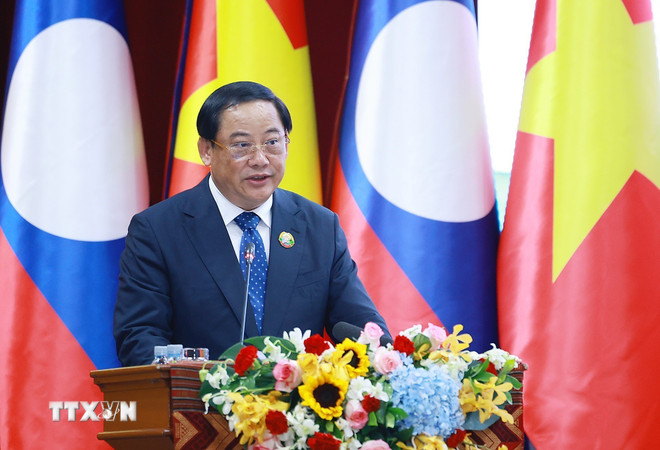
For his part, Lao Prime Minister Sonexay Siphandone stated that despite global challenges, the Lao economy continues to grow, with a projected 4.8% increase for 2025 and basic macroeconomic stability. He noted that the Parties and Governments of both nations have consistently provided close guidance on economic cooperation. He welcomed and pledged to facilitate Vietnamese investors in potential sectors such as electricity, transport infrastructure, high-tech agriculture, tourism, and finance-banking.
Agreeing with Prime Minister Pham Minh Chinh's major orientations, the Lao Prime Minister highlighted several priorities, including infrastructure connectivity projects such as railways and expressways linking Laos to Vietnamese seaports, the development of industrial zones, mineral processing, and carbon credit sectors. To facilitate investment, Laos will continue to refine legal regulations, reduce bureaucracy, promote digital transformation, and build a transparent business environment.
Setting out strategic development goals, including exiting least-developed country status by 2026 and becoming a high-middle-income country by 2055, the Lao Prime Minister urged businesses to leverage innovation and new development drivers. He also requested Vietnamese ministries to continue providing support and sharing experiences in implementing investment projects and connecting domestic economic regions with foreign investment.
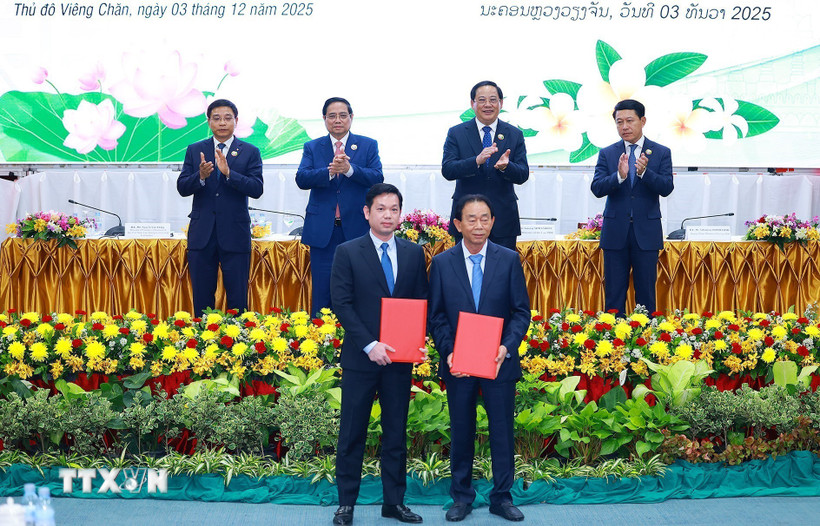
At the conference, in the presence of the two Prime Ministers, businesses from both countries signed and exchanged nine cooperation documents across various fields. This was the final activity of Prime Minister Pham Minh Chinh's working trip to Laos. On the evening of the same day, the Prime Minister and the Vietnamese delegation departed Vientiane for Vietnam, successfully concluding the visit.
-
/ News
Vietnam-Laos Investment Cooperation: Expectations for a 10 Billion USD Breakthrough
A series of major Vietnamese investment projects in Laos and the development of industrial linkage chains are expected to yield practical results, ...
-
/ News
Bringing Vietnam-Laos Cooperation into Depth, Substance, and Greater Sustainability
-
/ News / Activities
Strengthening Viet Nam – Laos Logistics Connectivity: Current Situation and Solutions
Abstract With a shared border of nearly 2,400 km and a special cooperative relationship, Viet Nam and Laos possess many favorable conditions to fo...